Context Over Models: What Really Matters When Choosing an AI Platform
When choosing an AI platform, companies compare the various models, features, and licensing prices offered by Vendors. However, long-term success depends on something else:
Which AI platform provides access to the relevant business data.
High investments with often unknown benefits
Gartner forecasts global AI spending of $2.7 trillion for 2026 – a 49.5 percent increase from the previous year. According to Gartner, only one in five companies currently reports significant added value from AI. Many organizations are still in the early stages of their AI initiatives. They know neither the actual business benefits nor the long-term costs, yet they still must decide on which platform their AI will run in the future. Vendors, in particular, are pushing for a commitment to their respective platforms with attractive offers – for example, during renewal negotiations – without many companies actually being aware of their requirements and relevant use cases. Companies usually compare only models, features, and prices. However, other factors are often of greater importance in this decision:
Context Layer—The Layer Between Data and Model
A language model can formulate, summarize, and perform calculations. It knows nothing about the company. If a sales representative asks, “Which orders from Customer X are pending, and are there any current complaints?”, the model needs data from the ERP system, ticket system, and CRM.
Vendors refer to the layer that brings together relevant data and partial results as the context layer. It consists of three parts:
- Connection: It retrieves data from the source systems – either via a pre-built search index from which relevant content is retrieved (Retrieval-Augmented Generation), or as a live query via interfaces such as traditional APIs or the Model Context Protocol (MCP).
- Semantic model: It defines what terms such as “active customer” or “contribution margin” mean within the company and how objects are related to one another – for example, order, customer, and contact person.
- Permissions: They ensure that the AI shows each person only the data they are authorized to access.
This layer requires that data in the source systems be complete and consistent. A context layer makes incorrect master data available more quickly but does not correct it. Adequate data quality is a fundamental prerequisite for the successful use of AI.
Four Vendors – One Plan for the Leading AI Platform
Major platform providers are now building their AI strategies around this layer, as these examples clearly demonstrate:
SAP describes the Business Data Cloud as the source of business context for its AI. Joule agents access its knowledge base, responses are based on the SAP Knowledge Graph, and shared business definitions are intended to connect the agents with one another.
Salesforce renamed its Data Cloud “Data 360” in October 2025 and placed it under the Agentforce 360 brand. The product provides agents with context, and a proprietary semantic data model ensures that metrics remain consistent across all Salesforce clouds.
At Ignite 2025, Microsoft introduced Microsoft IQ: Work IQ builds on Microsoft Graph and provides Copilot with context from emails, files, meetings, and chats, while Fabric IQ defines business terms such as “customer” for reports and agents.
With Workflow Data Fabric, ServiceNow promises its AI agents real-time access to data from across the entire enterprise via connectors to data platforms such as Snowflake, Databricks, or Oracle.
Each of these offerings solves the context problem within its own platform, and all vendors claim to be the leading AI platform. According to the vendors, this should now solve the problem – or does it?
The next vendor lock-in trap is called AI context
Some vendors have begun restricting access to the enterprise data that AI requires – or are charging exorbitant fees for access.
In the summer of 2025, Salesforce changed Slack’s API terms. Since then, third-party providers have been prohibited from exporting Slack data on a large scale, creating permanent copies or search indexes from it, or using the data in language models. Glean, a vendor whose AI search had indexed Slack content, had to inform its customers that access is now only possible on a request-by-request basis. Companies that had built their internal AI on a Slack archive had to rebuild their systems or switch to an integration approved by Salesforce.
A second case, in addition to Slack, illustrates just how seriously vendors are taking control over data access. With SAP Note 3255746, SAP has prohibited the use of the ODP-RFC interface by customers and third-party providers. Many tools had previously used this interface to extract data from SAP- systems. Since June 2026, a security patch has blocked such access; as an alternative, SAP recommends its own Business Data Cloud.
However, additional costs can also be a decisive factor. At Microsoft, for example, High-Capacity and certain Advanced APIs are billed based on usage and also require a linked Azure subscription. When large amounts of data are exported for analytics or data lakes, billing is based on the volume of data exported. The Azure price is currently $0.75 per 1,000 extracted objects.
The data continues to belong to the customers. However, in the event of an issue, the vendors determine how the AI accesses it. It remains to be seen whether and how access to corporate data will be restricted or subject to fees by other vendors.
Three Architectures with Three Types of Dependency
Most companies store their data in a distributed manner – across ERP solutions, data centers, and multiple cloud platforms. For the context layer, this leads to a fundamental decision between three approaches.
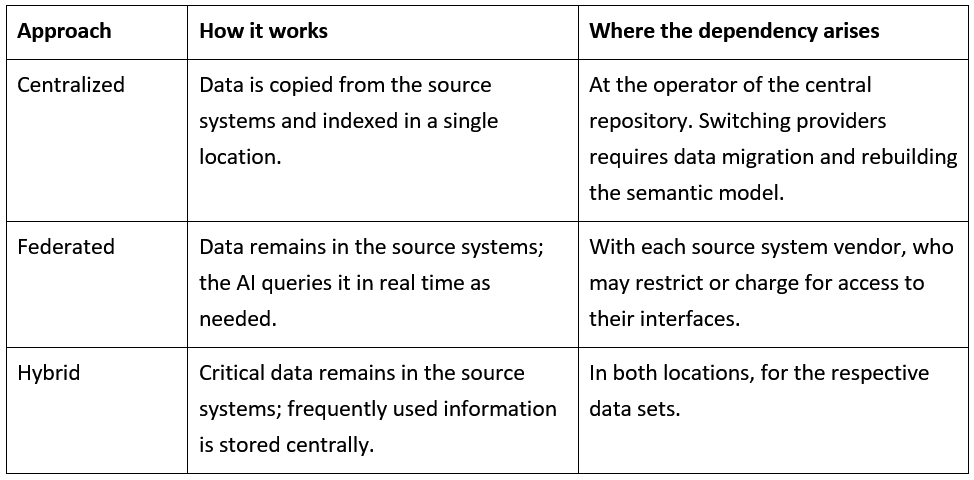
Which approach is best depends heavily on your own requirements, derived from relevant use cases, your IT landscape, and your IT strategy. A company with a single-cloud strategy and centralized data storage starts from a different point than one with a heterogeneous system landscape and intentionally distributed data storage. In both cases, it is not enough to compare investment and implementation costs: operations, governance, access costs to source systems, and the costs of a later exit must all be factored into the same calculation.
The Slack case and the SAP notice affect both sides of the equation. Salesforce has prohibited the central index, and SAP has closed an interface for data retrieval. Thus, none of the three architectures provides protection on its own. Protection only arises when the semantic model is available in an open format and the interfaces are contractually guaranteed.
In regulated sectors, an exit strategy is crucial
An AI platform with access to core data is a service provider in the IT supply chain, and as such, several regulatory frameworks require active risk management. The NIS2 Directive lists supply chain security among the mandatory measures for important entities, including operators of critical infrastructure. Under the Digital Operational Resilience Act (DORA), financial firms must list such third-party ICT service providers in an information register, assess concentration risk, and maintain an exit strategy for service providers that support critical or important functions.
For the context layer, this means that an exit strategy must describe how connections, the semantic model, and authorizations are migrated to another Vendor. If the semantic model is available only in a vendor’s proprietary format, the strategy effectively describes a complete rebuild.
Why the transition can be costly
Data can be copied, though not always easily or cheaply. The real effort lies elsewhere: in the months it takes for business units to define their terms, model relationships between business objects, and transfer permissions to the AI. This semantic model is the actual knowledge of the context layer.
Things get complicated when the semantic model is created using a vendor’s proprietary format and tools. When switching, the model and permissions must be rebuilt in a different environment, while the AI must continue to run during day-to-day operations. The longer the AI has been in production, the more processes depend on this model – and the more expensive and difficult the switch becomes.
Added to this is the contractual aspect. Salesforce was able to change the Slack terms via a notification; continued use was deemed consent. SAP shut down a widely used interface with a simple notice. In both cases, customers had no recourse but to migrate.
However, Salesforce also demonstrated the possibility of a more open approach: Together with Databricks, dbt Labs, and Snowflake, the goal is to standardize semantics across platforms. Whether a semantic model remains portable therefore depends on market developments as well as the decisions the company makes during its implementation.
Key Questions to Ask Before Choosing a Platform
Before a company commits to an AI platform, it should therefore answer at least six questions:
- Are the company’s own requirements clearly defined, and are there relevant use cases with proven added value from AI implementation, so that an informed decision can be made?
- Is the data available in sufficient quality and up-to-date as a basic prerequisite for ensuring the successful use of AI?
- In what format are term definitions, data relationships, and authorization rules available, and can they be exported in their entirety?
- Which interfaces of the source systems are contractually guaranteed, and can terms and conditions be changed unilaterally?
- Does the platform rely on open protocols and formats, or does it tie connectivity and semantics to its own tools?
- What does it cost to migrate connections, the semantic model, and permissions to another Vendor?
If the semantic model is available in an open format, the platform provider remains interchangeable. If it has evolved in a vendor-specific format, that vendor will have a say in future pricing and interfaces. Without satisfactory answers to these questions or sensible precautions to prevent problems, errors can only be corrected at great expense and with significant effort after the contract is signed.
With limited experience in an AI market characterized by constant change, companies face major challenges when it comes to decision-making. In addition, the legal framework and standards are still being developed. However, since we do not have a crystal ball to predict future market developments, transparency regarding our own requirements and use cases, careful decision-making preparation, and contractual agreements with Vendors are crucial when selecting the appropriate AI platform.
Author: Jessica Loi Müler