
Europe’s next sovereign Office Star
The Cloud Act, the Patriot Act, data transfers to third countries: Anyone who hosts their Office infrastructure with U.S. providers relinquishes a significant portion of their digital sovereignty. For companies in regulated industries, for public administration, and for any organization handling sensitive data, this poses a compliance risk.
For a long time, they remained in the background of the office software arena: open-source office suites as alternatives to the well-established big players. Thanks to the issue of “digital sovereignty” and stricter data protection requirements, alternatives to the established office platforms are finally in the spotlight. Just how much perceptions have changed was recently evident at the federal level: At the German government’s Open House 2026, the Federal Ministry for Digital Affairs and State Modernization (BMDS), together with the Center for Digital Sovereignty (ZenDiS), presented OpenDesk for visitors to try out on June 20 and 21. The BMDS has also taken on the patronage of the second open-source competition for public administration. Applications are still being accepted through June 30, 2026.
Microsoft itself is generating fresh applause for the European challengers with each round of awards. Effective July 1, 2026, the company is once again raising prices for its 365 Business subscriptions for business customers and public sector clients: Business Basic subscriptions have increased by 16 percent, Business Standard by 12 percent, and Frontline plans by 33 percent. Nicole Herskowitz, the manager responsible for Microsoft 365, attributed this to new features such as security, management, and, above all, new AI functionality. However, the full Copilot license still costs an additional 28 euros per user per month. Companies that do not want or need AI integration are therefore paying more for features they do not use.
The contenders from the open-source community have been making significant strides in recent years and are positioning themselves on the basis of data protection, transparency, and open standards. Many of these solutions can be operated in in-house data centers or with European cloud providers, offering greater autonomy and control over their own data. Driven by the strong momentum on the side of the alternatives and media interest, the search for the right office suite has begun anew—this time under different rules.
The European candidates take the stage
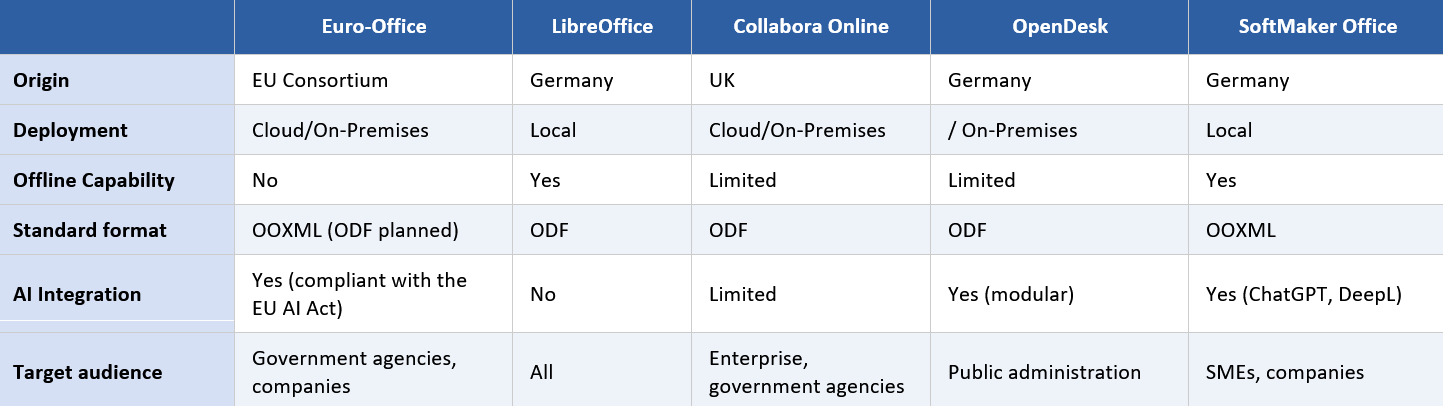
On June 9, 2026, a coalition of European technology companies, including Nextcloud, IONOS, and Proton, released the first stable version 1.0 of Euro-Office. The project is based on the open-source code from OnlyOffice and was released via public GitHub repositories under the GNU Affero General Public License v3 (AGPL v3); it is positioned as a GDPR-compliant alternative for government agencies, businesses, and educational institutions. Currently, Euro-Office is browser-based and can be integrated as a module into cloud services such as Nextcloud or Proton Drive. A local application for computers and apps for smartphones are set to follow. However, the challengers also score points with modern features such as the AI assistant integrated via Nextcloud. To meet the requirements of the EU AI Act, the developers disclose which language model is active in the background.
Prior to the launch, “The Document Foundation,” the organization behind LibreOffice, criticized the newcomer in an open letter. The first point of contention concerned marketing: Euro-Office markets itself as “the first open-source office suite developed in Europe.” OpenOffice was launched as early as 2001 and laid the foundation for LibreOffice in 2010, which has now been on the market for 15 years. More serious, however, is the criticism that the suite relies on the OOXML file format, which was developed and is controlled by Microsoft. This, they argue, contradicts the stated goal of European digital sovereignty. From their perspective, the open ODF format offers better conditions for independence and control over one’s own content. Using the Microsoft-controlled format, they contend, creates a new vortex of digital dependency. The EuroOffice developers acknowledged this and emphasized that proprietary formats pose a real obstacle to digital independence. In the long term, ODF is intended to replace Microsoft’s OOXML format as the standard in the suite. The decision to start with OOXML was a deliberate one, aimed at providing organizations with a compatible platform from which they can migrate gradually.
Despite the behind-the-scenes bickering and friction among the participants, the candidates present themselves on stage with a clear profile:
But even the best performance on stage is of little use if the audience in the concert hall can’t feel the song.
A familiar tune…
A major hurdle to the adoption of alternative office suites is employees and their habits: Anyone who learned to work with Word and Excel as a student is unlikely to switch voluntarily in their professional life. Microsoft runs programs to address this “software socialization”: The Office 365 A1 plan is free for students and their educational institutions, and through the “Enrollment for Education Solutions” licensing program, universities and colleges can rent Microsoft products at a low cost. In contrast, Harald Wehnes, spokesperson for the Executive Committee’s Working Group on Digital Sovereignty at the German Informatics Society (GI), called for cost parity in the education sector for OpenDesk as an alternative to M365—specifically, the free provision of OpenDesk to colleges and schools—at the 2026 European Digital Summit. He argued that today’s acceptance of these solutions leads to tomorrow’s dependence by locking in the next generation over the long term.
Thus, open-source alternatives began to sing a similar tune with the support of their respective governments: As part of its “digital + sovereign” initiative, Schleswig-Holstein integrated LibreOffice and FOSS into schools and government administration. In the Netherlands, Cloudwise has formed a partnership with Nextcloud to build a data-protection-compliant learning and working environment for Dutch schools. France took a hard line in the education sector and banned the use of M365 and Google Workspace in French schools because they do not comply with the GDPR.
Nevertheless, alternative providers still face a long and rocky road ahead: Microsoft has institutionalized user adoption over decades through free or heavily discounted licenses. Open-source alternatives have begun to follow the same path, but structurally lag far behind Microsoft.
The final decision rests with the public
The demand for digital sovereignty, GDPR-compliant solutions, and greater control over one’s own data is currently providing a tailwind for European office software providers. Projects such as Euro-Office, OpenDesk, LibreOffice, and SoftMaker are benefiting from the fact that more and more organizations want to reduce their dependence on large providers, as well as from the political climate that is becoming more open to sovereign solutions.
According to Nexcloud, strong demand is coming in particular from the public sector, which processes highly sensitive and regulated data, as well as from small and medium-sized enterprises that want to protect their intellectual property and reduce their dependence on large cloud providers.
Office suites are evaluated, among other things, based on whether employees can use them to get their work done just as reliably as before. For this reason, European providers rely on Microsoft’s familiar user interfaces. The user interfaces are often modeled after established Office products to keep training efforts and migration costs as low as possible. At the same time, new ecosystems are emerging around open standards. The transition does not have to happen overnight: A phased approach combines existing solutions with the gradual replacement of individual components. Those who rely on specific Microsoft functions can either combine them or migrate gradually. The key factor, then, is whether European alternatives are perceived as viable long-term options.
By now, nearly all contenders have mastered spreadsheets, presentations, and word processing. What will be decisive, however, is whether they can build their own ecosystem of users, service providers, educational institutions, and software partners. The question is whether companies, government agencies, and educational institutions are actually willing to adopt these alternatives. The contenders are on stage. It is now up to the audience to decide whether one of them will become the next superstar.
Author: Cüneyt Baluch