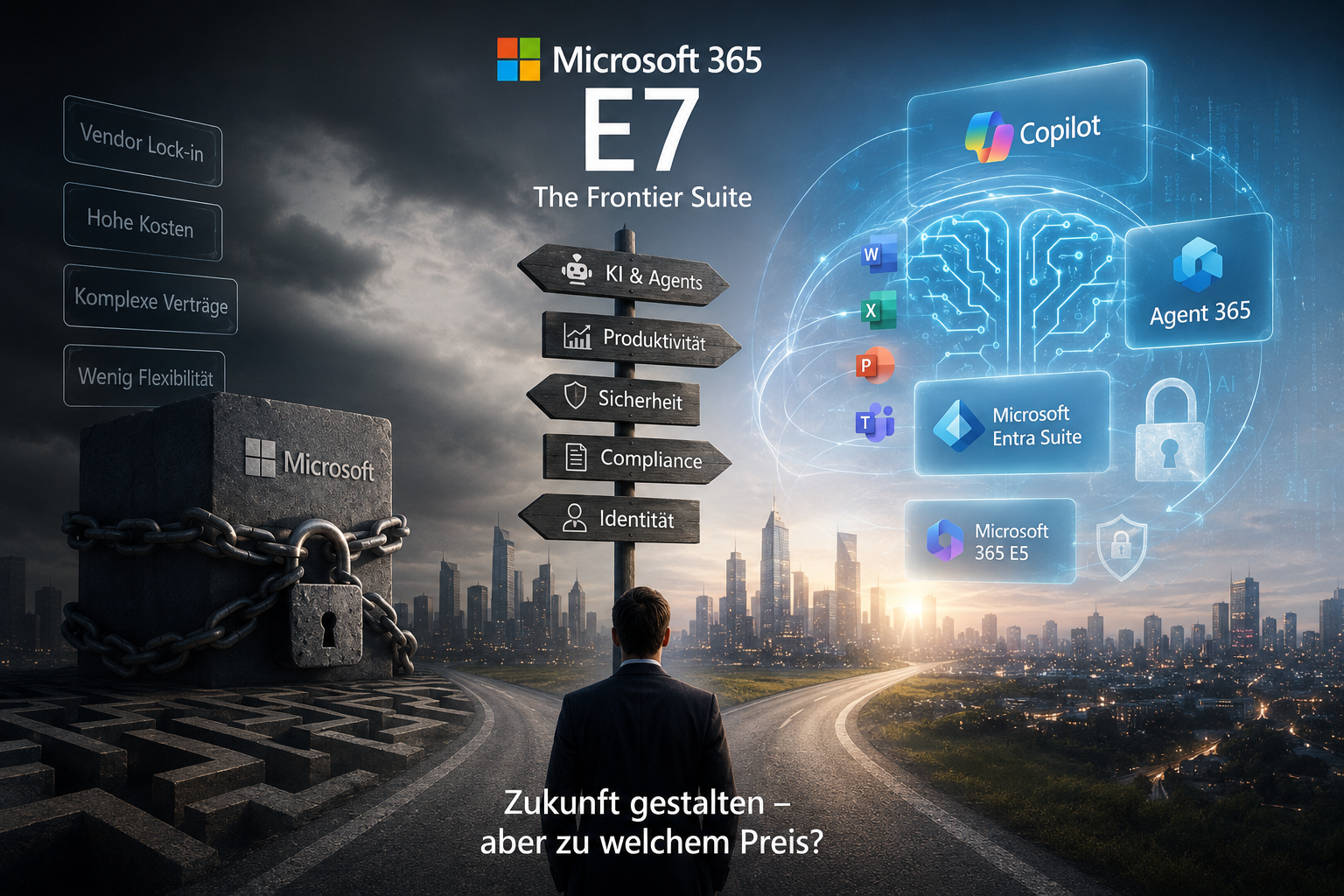
More AI, More Control, More Costs: What’s Behind Microsoft 365 E7
With the new Microsoft 365 E7, Microsoft introduced the first new enterprise licensing tier since the launch of E5 in 2015. Officially, Microsoft calls the package “The Frontier Suite”—and the name alone makes it quite clear where the journey is headed: more AI, more automation, and an even stronger tie to the Microsoft ecosystem.
General availability began on May 1, 2026. E7 is priced at €91.90 per user per month, positioning it significantly above the previous E5 license (€55.20).
That’s quite a statement. Especially when you consider that many companies are still debating whether E5 is even worth the investment.
What exactly is Microsoft 365 E7?
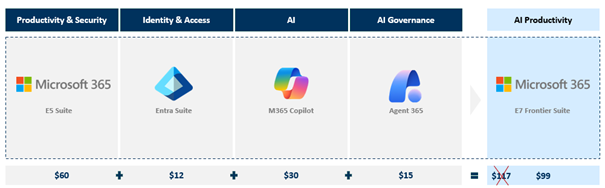
At its core, E7 isn’t a completely new product, but rather a large bundle of existing Microsoft services—enhanced with new AI and agent features. Microsoft combines the components of M365 E5, M365 Copilot, Entra Suite, and Agent 365. The goal is clear: to provide companies with a central platform where productivity, security, and AI are as closely integrated as possible.
Microsoft, of course, argues that the bundle is more cost-effective than licensing the individual products separately. If you add up the components, the total does indeed exceed €91.90 (equivalent to $99). Nevertheless, the question remains: how many companies truly need all components to their full extent? Especially with E5, it’s already common today for many features to be paid for but not actively used.
The Real Focus: AI Everywhere
The most important difference from previous M365 plans is clearly the massive AI integration. Microsoft entered the market relatively early with M365 Copilot. Initially, however, much of it still seemed like a rather expensive chatbot with PowerPoint- integration. With E7, Microsoft is now going significantly further. The focus is on so-called “Agentic AI” functions. The idea behind this is that AI doesn’t just provide support, but performs tasks independently.
Microsoft refers to this as a “human-led, agent-operated” approach. AI agents are designed, for example, to prepare meetings, respond to emails, analyze data, coordinate workflows, access corporate data… and do so as autonomously as possible.
Agent 365 is a particularly new feature here. The product essentially serves as a management and governance layer for AI agents (both Microsoft’s own and those from other providers) within a company.
It is very clear here that Microsoft views AI agents as “digital employees” in the long term. These agents are assigned identities, permissions, policies, and security requirements—similar to regular user accounts.
Microsoft’s Strategy Behind This
Upon closer examination of E7, the whole thing seems less like a standard license upgrade and more like a strategic shift in direction. Microsoft is pursuing several goals simultaneously.
The most obvious goal is, of course, profit. Microsoft has been investing billions for years in AI infrastructure, data centers, and partnerships with OpenAI. At the same time, many customers’ actual willingness to pay appears to have fallen short of expectations so far. Several reports indicate that while Copilot adoption is high, only a relatively small portion of users actually use the paid licenses. E7 therefore also appears to be an attempt to integrate AI more deeply into existing enterprise contracts, rather than relying on voluntary individual purchases.
The second point is the classic vendor lock-in. The more companies integrate Copilot, Agent 365, Entra, Defender, and Purview with one another, the more difficult it will be to switch to other platforms later on. With E7, everything is increasingly being consolidated into one large, comprehensive solution. While this is convenient, that is precisely where the danger lies. Because the more business processes, data flows, and AI agents are deeply integrated into Microsoft, the higher the switching costs will be later on—not just technically, but also organizationally.
My Conclusion
From a technical standpoint, M365 E7 is a fairly logical step. Microsoft is no longer trying to sell AI as an add-on feature, but as an integral part of modern business operations. The direction is understandable: more automation, more integration, and more centralized control. Nevertheless, there remains a certain aftertaste. In many respects, E7 feels less like a pure innovation and more like an attempt to draw customers even deeper into its own ecosystem while simultaneously securing a return on its massive AI investments. E7 can certainly make sense for companies - especially those that already rely heavily on Microsoft and plan to use AI productively. But as is often the case with Microsoft, the same principle applies here: Just because a feature is available doesn’t mean you have to license it automatically.
If you need a more in-depth evaluation of E7 or support with Microsoft contract negotiations and licensing strategies, please feel free to contact us: mail@complion.de